Read the transcript and production notes
Download the film as MP4 ↗︎
October 2026 edition. These are independent, AI-assisted projects. Website captures show my own portfolio. Returnspan uses a fictional review case; Edge and the workflow diagrams are labeled illustrations. Product checks do not establish a public release, customer outcomes, or trading performance. Real stock footage: Darlene Alderson / Pexels. The narrator uses the existing stock synthetic voice.
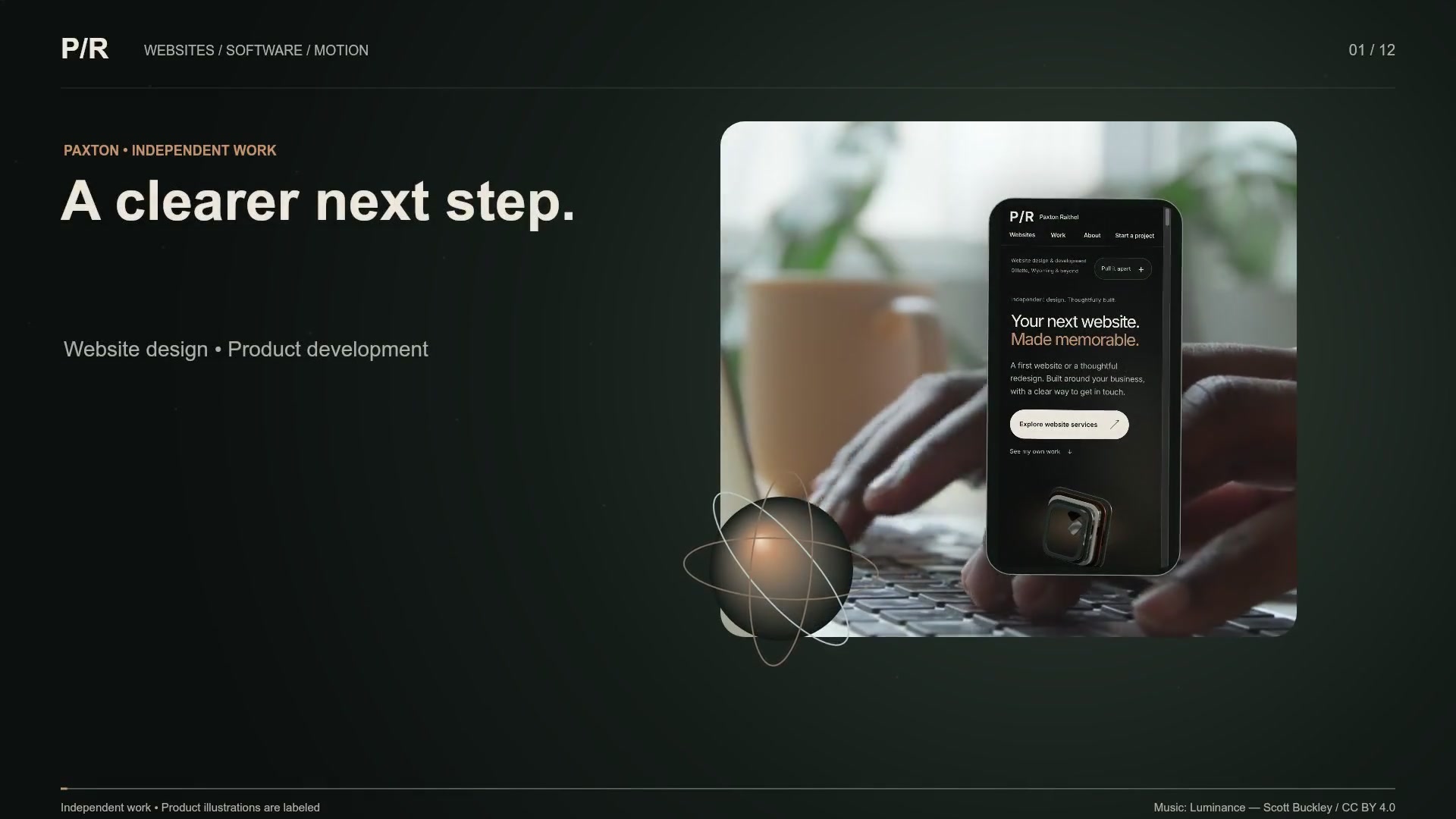
0:00 / A clearer next step.
A website has one chance to make the next step feel obvious. Someone arrives on their phone, looks for what you do, and decides whether to keep going. The job is to earn that next moment. This is how Paxton approaches websites and software: make the experience distinctive, then make it easy to use.
0:25 / Make the route obvious.
Start with the person visiting, not a list of features. What do they need to understand? What proof can they actually see? And what is the simplest useful action? A clear headline, a relevant example, and one well placed contact route can work together. Every moving element should help that journey instead of asking for attention of its own.
0:50 / The work is the proof.
This portfolio is a working example. The opening sculpture can separate into space on a computer, then gather back into the page as you move through it. On a phone, the composition stays contained and the controls remain accessible. The creative idea matters, but so do readable type, comfortable spacing, and links that arrive where you expect.
1:15 / Motion with a purpose.
Good motion connects one state to the next. A shape becomes a frame. A frame becomes a page. A button responds to the action you just took. Those connections make an interface feel deliberate. They also have limits: movement should settle, text should remain readable, and people who prefer reduced motion should still get the complete experience.
1:40 / Start with the right scope.
For a business without a standalone website, start with the essentials: the offer, useful proof, and a clear way to make an inquiry. For an existing site, keep the assets that already work and fix the part that needs attention. A small repair and a full redesign are different jobs. Scope, price, timing, and access are agreed before the work begins.
2:05 / Returnspan.
Returnspan explores a smaller, practical software problem: keeping a return and its credit connected through the work that follows. The aim is a clear record of what happened, what remains open, and what needs attention next. It is a product in development, with fictional review cases used to test the experience. Customer adoption and paid results have not been established.
2:30 / Know where the work stands.
The interface should make the current state easy to read. A person should be able to open the relevant case, make a deliberate change, and understand the result without learning an internal ticket format. The review process checks the real interface as well as the underlying records. An attractive screen is only useful if the action behind it is dependable.
2:55 / A retry must not become two.
Recovery is part of the product. Sometimes the server receives a save but the browser does not receive the response. Repeating that request carelessly can create duplicate work. Returnspan has been tested against this kind of interruption with a fictional case and a database check. Those tests support a specific recovery result, rather than a promise that every possible failure is solved.
3:20 / Edge Lab.
Edge Lab takes the same approach to a different workflow: helping a discretionary trader preserve context and review decisions. The intended path connects a chart, a decision, and a record that can be reopened later. Its chart connection and capture acceptance remain under review. This illustration explains the intended flow; it is not a live market feed, trade recommendation, or claim of profitability.
3:45 / The surface is only half.
Behind a calm interface are the decisions that protect the work. Access needs to be scoped to the right person. Inputs need validation. Failed operations need clear outcomes. Records need a recovery path. Those requirements are tested at their actual boundaries. A local test is not the same as a production rollout, and an attractive demo is not a security certificate.
4:10 / Build. Use. Improve.
The process is collaborative. Define a useful outcome, build a coherent version, and put the real flow under review. Use direct feedback to remove confusion and improve the next iteration. Paxton works with AI assistance for implementation and independent checks, while retaining responsibility for the choices and release decisions. The goal is software people can understand and use, not a larger feature list.
4:35 / Let’s make the next step clear.
If your business needs a first website, a clearer existing one, or help with a specific visitor problem, start with a conversation. Share what the business does, the current site if there is one, and what you want people to do next. The next step is an agreed scope, not a surprise commitment. Explore the website work and get in touch.
Synthetic narration: Kokoro-82M, stock af_heart voice. Original motion graphics and editing prepared for this film.